








Learning to drink from a cup: helping your baby drink independently
That first sip from a cup might seem like a small moment, but for your baby, it is a whole new discovery. Holding a cup, placing their lips around the rim, taking a sip and learning how much to drink all require new skills.
And honestly? The first attempts probably won't go exactly as planned. Water gets spilled, the cup gets turned upside down, your baby mostly plays with it and sometimes more water ends up on the table than in their mouth. That's all part of it.
Learning to drink is a process. Just like learning to walk or eat independently, it takes time and plenty of practice.
When can babies start drinking from a cup?
From around 6 months, when your baby starts eating solid foods, you can offer water alongside their usual milk feeds. This can also be a good time to introduce drinking from a cup. In the beginning, there is no need to drink large amounts. A few small sips with a meal are enough to practise.
Every baby develops at their own pace. Some babies quickly figure out how to hold a cup, while others need more time to get used to the movement and sensation of drinking from a cup.
There is no exact age when your baby has to be able to drink from a cup. Think of it as a new skill to discover together.
Why choose an open cup?
An open cup helps your baby learn a different way of drinking. They practise bringing the cup to their mouth, placing their lips around the rim, controlling the amount of liquid and swallowing.
Drinking from an open cup can also support oral motor skills and hand-eye coordination. Health professionals generally recommend introducing an open cup rather than relying on a spout cup as a necessary step.
A spout cup or straw cup can of course be practical in some situations, especially when you're out and about. But a spout cup isn't a necessary step before learning to drink from an open cup. You can introduce an open cup directly.
How to teach your baby to drink from a cup
1. Choose a calm moment
Try during a mealtime when your baby is relaxed. A few sips are enough. The goal isn't to finish a whole cup straight away.
2. Start with a small amount of water
Put just a little water in the cup. This makes practising easier and means there is less water to spill.
From around 6 months, you can offer water alongside breast milk or formula. In the beginning, a few sips are enough.
3. Help your baby with the movement
You can gently hold the cup together and bring it towards your baby's mouth. Let them explore as much as possible, but offer help when needed.
In the beginning, your baby may cough or splutter a little. This can happen while they are getting used to a new way of drinking. Stay calm and give them time to practise.
4. Expect a little mess
Water on the table? A wet sleeve? A cup tipped over? It happens.
By practising, your baby gradually learns how much pressure to use, how to bring the cup to their mouth and how to take a sip.
Common challenges when learning to drink
“My baby just plays with the cup”
Very normal. For young children, a cup isn't just something to drink from. It's also something new to explore. Holding, turning and touching it are all part of learning.
“My baby only drinks a few drops”
That's completely fine when you're just starting. In the beginning, it's mainly about getting used to the cup and practising the movement. Every baby is different.
“My baby makes a huge mess”
It can be frustrating, especially when you've just cleaned everything up. But spilling is part of learning to drink independently. Your baby is discovering how much force to use and how the cup works.
Do's & don'ts when learning to drink from a cup
Do's
Start calmly and without pressure
Let your baby practise as much as possible
Offer small amounts of water
Choose a cup that is easy for little hands to hold
Practise regularly during mealtimes
Keep drinking relaxed and enjoyable
Don'ts
Don't expect your baby to drink neatly straight away
Don't force your baby to take a sip
Don't worry too much about spills
Don't keep postponing an open cup because you're worried about the mess
Don't feel that you need to use a spout cup as a necessary step
Which cup is best for a baby?
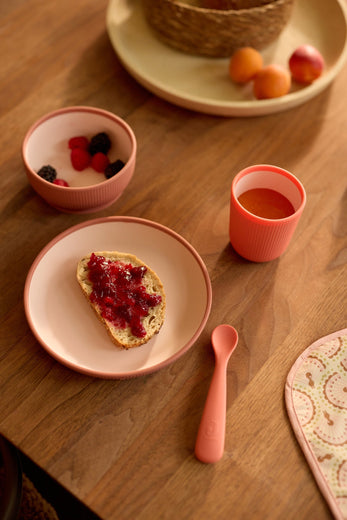
A good learning cup doesn't need to be complicated. For little ones, it helps if the cup is lightweight and easy to hold. An open cup in a size that suits small hands can make practising independent drinking a little easier.
Our silicone cups are designed for those first drinking moments: easy for little hands to hold and made for everyday use. From that first careful sip to becoming more independent, learning to drink happens one little step at a time.
Because those first attempts don't have to be perfect. They just have to happen together.
A wet table, a few drops on the floor and a big smile? That's what being at home with little ones is all about.
Frequently asked questions about drinking from a cup
When can a baby start drinking from a cup?
From around 6 months, you can offer your baby water alongside their usual milk feeds and introduce them to drinking from a cup. Every baby develops differently, so look at your baby's cues and readiness.
Is an open cup better than a spout cup?
An open cup is a good way to help your baby practise a natural drinking pattern. A spout cup isn't a necessary step before learning to drink from an open cup.
Can my baby learn to drink from a straw cup?
Yes. A straw cup can be a practical option, especially when you're out and about. It's still useful to give your baby opportunities to practise with an open cup as well.
How can I stop everything getting wet?
Honestly, you probably can't completely. Start with a small amount of water and practise during a mealtime. Putting a cloth underneath the chair can help too.
A little mess is simply part of learning to drink. And luckily, wet tables eventually dry.